5. The repeat prescribing patient partnership agreement

5.1 The NHS Constitution
5.2 Supporting patients and their carers
5.3 Useful resources
5.4 Questions for the general practice patient participation group
5.5 Resources to help patients to understand the repeat prescribing process
The repeat prescription request and authorisation process - patient information


Many patients take medicines as repeat prescriptions to help manage their long-term conditions. But it is not uncommon for patients to express their confusion about what all the medicines are for, when they are supposed to take them and their concerns about taking medicines for long periods of time.

The prescribing and taking of medicines should be seen as a partnership between the healthcare professional and the individual; both bringing their relevant expertise and experience and agreeing the right way forward together – shared decision-making (SDM).

Repeat Prescribing Toolkit Section 5 Venn Diagram

Safe and effective healthcare is achieved through partnership between healthcare professionals and patients. The World Health Organisation encourages patients to be more actively involved in their own healthcare and use of medicines. They have a useful infographic for patients outlining the five moments for medication safety.

5.1 The NHS Constitution

To promote a good partnership between healthcare professionals and patients, it is important to recognise that patients can make a positive contribution to their own and their family’s health and wellbeing. To help patients and healthcare professionals work together, the NHS Constitution says:

Please recognise that you can make a significant contribution to your own, and your family’s, good health and wellbeing, and take personal responsibility for it.

Please provide accurate information about your health condition and status.

Please follow the course of treatment which you have agreed, and talk to your clinician if you find this difficult.

5.2 Supporting patients and their carers*

Prescribers and patients need to work together through shared decision-making to ensure that patients receive the right medicines for them and are engaged in the repeat prescribing process.

Below are key expectations to support patients in taking their medicines:

  • Patients (or their carer, where appropriate) are at the centre of their care, especially in relation to the medicines they are prescribed
  • Through shared decision-making, the benefits and risks of repeat medication need to be clearly understood
  • Patients should be encouraged to share what is important to them in relation to their repeat medication
  • As a key partner in their healthcare, patients should be supported and encouraged to take ownership and responsibility for their repeat medication. This includes the timely and safe ordering, collecting, storing and taking of medicines as prescribed
  • Prescribers should confirm a patient’s understanding of, and reason for taking a repeat medication and discuss any concerns and expectations
  • Pharmacies (and dispensing doctors) supplying medicines to patients should do so safely and ensure that key messages around how to use the medicines safely are communicated in a way that the patient understands
  • Patients should be encouraged to share with their prescriber if they are not taking any of their repeat medication as intended and their reasons for that.

* Where a patient is unable to take responsibility for their medicines, it is assumed that this responsibility passes to their carer.

5.3 Useful resources

The following materials have been designed with patients and tested in primary care in England. They have been shown to help patients engage in their repeat prescribing and make the most of their structured medication review:

5.4 Questions for the general practice patient participation group

  1. Do you think the practice repeat prescribing process is clear and understood by most patients registered with this practice?
  2. Would you describe the process as timely, safe and effective?
  3. Are there any parts of the repeat prescribing process that patients think could be improved?

5.5 Resources to help patients to understand the repeat prescribing process

The following patient partnership agreement and the patient information leaflet have been designed with patients to help GP practices and community pharmacies ensure that more patients understand the repeat prescribing process and their own roles and responsibilities within it.

Repeat prescribing patient partnership agreement

What can you expect from your NHS Repeat Prescribing system?

Your prescriber

When your prescriber (e.g., GP, pharmacist or nurse) authorises that your medicine(s) can be repeated, they will set out how often you can have the medicines (e.g., monthly or every two months) and for how long (e.g., up to a year). After this time, you should receive a notification for a medication review to check how you are getting on with the medicines, if they are working for you and if you need to continue to take them.

See the Health Innovation Network’s information on how to support patients having a structured medication review, which includes a helpful animation.

The practice will explain the repeat prescribing process to you and their preferred way for you to order your repeats, e.g., via the NHS app. Your request for repeat medication will be processed
carefully by the GP practice. This involves a clinician authorising that the medicine(s) is still appropriate and safe for you to take and can be re-issued. This process can take a few days to complete. If there is a query, they will contact you for more information.

See repeat prescribing flow diagram.

Your community pharmacy (or dispensing doctor)

Once your prescription has been authorised, you can either collect it or it will be digitally transferred to your nominated community pharmacy. This is known as the electronic prescription service (EPS).

If you receive your medicines from a dispensing practice, they will send the prescription directly to the dispensary.

It will take the pharmacy or dispensary time (which could be a number of days) to order your medicine(s), check that it is safe for you to take and then dispense your medicine(s) ready for you to collect.

You may be eligible for electronic repeat dispensing (eRD) where the prescription can be authorised for up to a year, enabling you to collect it from the pharmacy without ordering from the practice.

For more information, see this helpful animation.

What are your responsibilities to ensure you get your repeat medication safely?

You

Please order your medicine(s) in plenty of time to allow the GP and pharmacy to check, authorise and dispense your medicine(s) BEFORE you run out.

Please DO NOT over order medicines. Your GP practice can check the quantity of medicines that you have ordered.

Over ordering is unsafe, costs more money and can result in medicine shortages. Only order what you need. See the NHS Dorset website for more information on medicines waste.

Please check your medicines as soon as you receive them to ensure you have exactly what you expected. If you have any questions or concerns, please ask. See I Manage My Meds for help and support.

Please tell your pharmacist or GP if there are any medicines you are no longer taking, or if you are taking any new over-the-counter medicines or medicines prescribed from the hospital or privately.

Please do not reorder any medicines that you have agreed to stop taking.

Some medicines require regular monitoring. This might be in the form of a regular blood test or more frequent medication reviews. If you need blood tests, please follow local guidance, and book your tests as often as is necessary. These tests are vital to ensure that the medicine is safe for you to have on repeat.

Most patients will be invited to take part in an annual medication review or structured medication review. This is to help ensure you still require and benefit from your medicines and to give you the opportunity to discuss with your doctor, pharmacist or nurse if you have any questions or concerns in relation to your medicines.

Medication reviews are required to keep you safe and to allow you the opportunity to speak to your doctor or pharmacist or nurse about anything you are worried or confused about.

Failure to participate in your medication review may mean that it is no longer safe for your practice to authorise your medicine(s). This could result in your prescription not being reissued until a review has been completed and it is safe to prescribe.

In certain situations, there are emergency supply routes for repeat prescriptions. Please only use these as a last resort. Abuse of such systems can present a risk to medication safety and causes increased workload for the NHS.

PLEASE return all unused medicines to the pharmacy to be disposed of safely.

Please treat all GP practice and pharmacy staff with respect. They are working hard to ensure your medicines get to you safely and on time.

An example/template patient information leaflet that practices may wish to use is included below.

The repeat prescription request and authorisation process – patient information (practice to complete)

RPS brandmark Royal College of General Practitioners logo

What is a repeat prescription?

Some medicines may be required to be taken on an ongoing basis to help manage your long-term condition. This is a repeat prescription.

Usually, one- or two-months’ supply can be issued on a prescription and be repeated over a timeframe agreed with you before you may need another appointment or medication review.

Some medicines require closer monitoring or blood tests between appointments to make sure the medicine or the dose is effective and safe for you.

Some medicines are not issued on repeat because they require more regular reviews. Examples include strong pain killers or sleeping tablets. Your prescribing healthcare professional will discuss this with you on an individual basis.

How do I request a repeat prescription?

Ways to request your repeat medication include:

  1. Via the NHS app or NHS website – this is the fastest route as it goes straight to the practice inbox
  2. Online via our website
  3. In person – request forms are usually available in reception.

Usually, requests cannot be taken over the telephone (to avoid errors being made).

We may ask you to nominate a preferred pharmacy for your prescription to be sent to electronically. This is known as your ‘nominated community pharmacy’. If you are registered at a dispensing practice, the
prescription will be printed in the dispensary.

How long will it take for my prescription request to be processed?

We aim to process your prescription request within [X please insert] working days.

This is due to the large number of requests we receive daily, and because there are several steps involved in ensuring the prescription request is safe to be authorised.

The prescription is then usually sent electronically to your chosen pharmacy or can be printed and collected.

There is the option to track your prescription request using the NHS app or website.

Please be aware at particularly busy times of year, for example, around bank holidays, you will need to order earlier than usual to receive your prescription on time.

There may be delays from time to time, but we always do our best to ensure you receive your medicines safely and on time.

How do repeat prescriptions work?
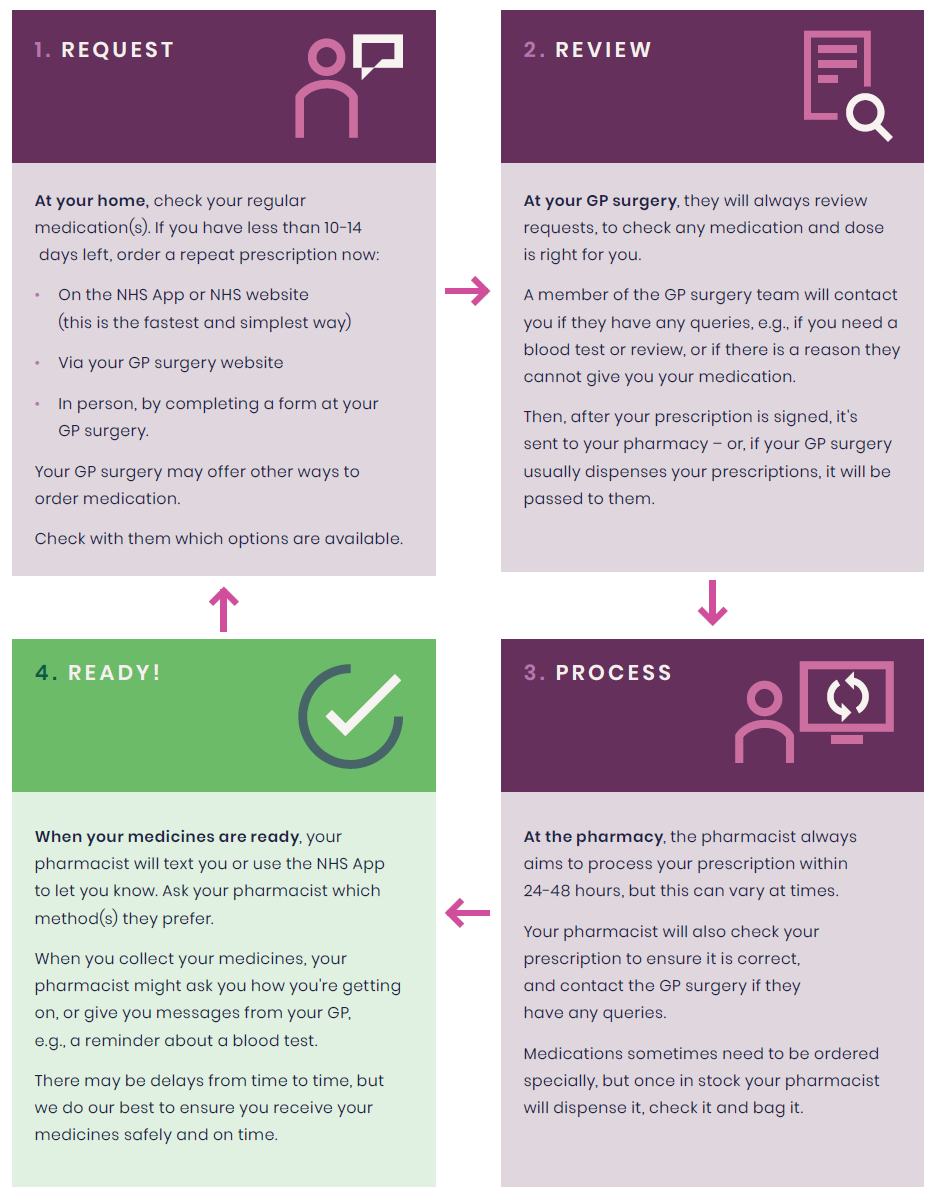
Flowchart: How do repeat prescriptions work?

Urgent requests

Please try not to run out of your medicines. When you are running low, e.g., have two weeks’ supply remaining, please request the next prescription.
If you accidentally run low or run out, we will try to process your request as quickly as possible, but please remember that the request process must be carried out thoroughly and safely and that GP practice teams are extremely busy.

Emergency supply requests for medicine can be requested from NHS 111 or 111 Online in an urgent situation. The pharmacy will check the GP record/National Care Record to ensure that they are not making duplicate supplies to ensure your safety and reduce waste.

What is a medication review and a structured medication review?

A medication review is usually arranged annually, sometimes more frequently, depending on the medication or condition being treated. A structured medication review is a more in-depth discussion between you and a GP or pharmacist. It is an opportunity to understand how you are managing with your medicines and for you to share any worries or concerns you may have. See the Health Innovation Network’s helpful animation.

Medication reviews are important, even if you have been taking the same medication for a very long time. The medication review enables you to raise any questions or concerns you have with your prescriber. It is the opportunity to discuss the benefits and any unwanted effects of your medicines to ensure you are getting the best possible treatment.

Some medicines require tests to be carried out before your medicines can be safely re-authorised to you. For example, blood tests or blood pressure checks. If you have been asked to have any regular tests or monitoring, please book in for this before your medication review.

Messages on your prescriptions

Sometimes we will communicate with you via your prescription. For example, we may give you a reminder about forthcoming blood tests.

When you collect your prescription, the pharmacy will mention this. You can always ask your pharmacist to check for any messages that may have been sent with your prescription.

What is electronic repeat dispensing (eRD)?

Patients who are stable on their medication and up to date with blood tests or monitoring could have their prescription on an electronic repeat, called eRD.

eRD allows your GP or healthcare professional to authorise up to a year’s supply of your repeat medication. You can collect your prescription every month or every two months from the pharmacy without having to order it. eRD is reliable, secure and confidential. Your regular prescriptions are stored securely on the NHS database, so they'll be ready at the pharmacy each time you need them.

Please speak to your healthcare professional during your next routine consultation, or talk to your pharmacist about whether you might be eligible for eRD.

The NHS Business Services Authority has more eRD information for patients.

How to avoid unnecessary medicines waste

Please do not over order your medication. Once issued by your pharmacy or dispensary, medication cannot be reused and will always be destroyed when returned to the pharmacy.

If we notice you are ordering medicines too frequently, we may advise that you have a medication review and stop further prescriptions until we have spoken to you.

See the NHS Dorset website for more information on medicines waste.

IMPORTANT

All prescription-only medicines have been carefully assessed for their safety before they were licensed to be prescribed. Your prescriber and your pharmacy team will check if the medicines prescribed are safe for you. It is NOT safe to share your prescription-only medicines with friends, family members or colleagues.

DO NOT SHARE your prescription medicine(s). According to the Medicines and Healthcare Products Regulation Authority, anyone who shares their prescription medicines, even with a family member, is breaking the law.

The Medicines act specifies that prescription drugs should only be supplied to the individual for whom they were prescribed.