6. Good practice examples and tools
6.1 Example: Repeat medicines monitoring
6.2 Example: Reducing waste and improving environmental sustainability
6.3 Example: Utilising digital capability to reduce workload
6.4 Example: QI improvement tools and case studies
6.5 Example: Supporting the safer prescribing of higher risk, repeat medicines
6.6 Example: Engaging with patients
6.7 Supporting vulnerable patient groups
As part of the toolkit development process, we and RCGP asked our networks to submit examples of repeat prescribing good practice. In this section, we set out a number of these example to showcase how primary care teams have improved their repeat prescribing systems.
6.1 Example: Repeat medicines monitoring
Using the skill-mix across the PCN team and the searches available in it the GP clinical system, Symphony Healthcare has created a scorecard to provide a snapshot of performance across multiple indicators including high-risk medicines monitoring. A standard operating procedure for recalling patients has been developed.
This supports an approach of proactively notifying patients when monitoring tests are due and reactively reminding them when issuing prescriptions.
6.2 Example: Reducing waste and improving environmental sustainability
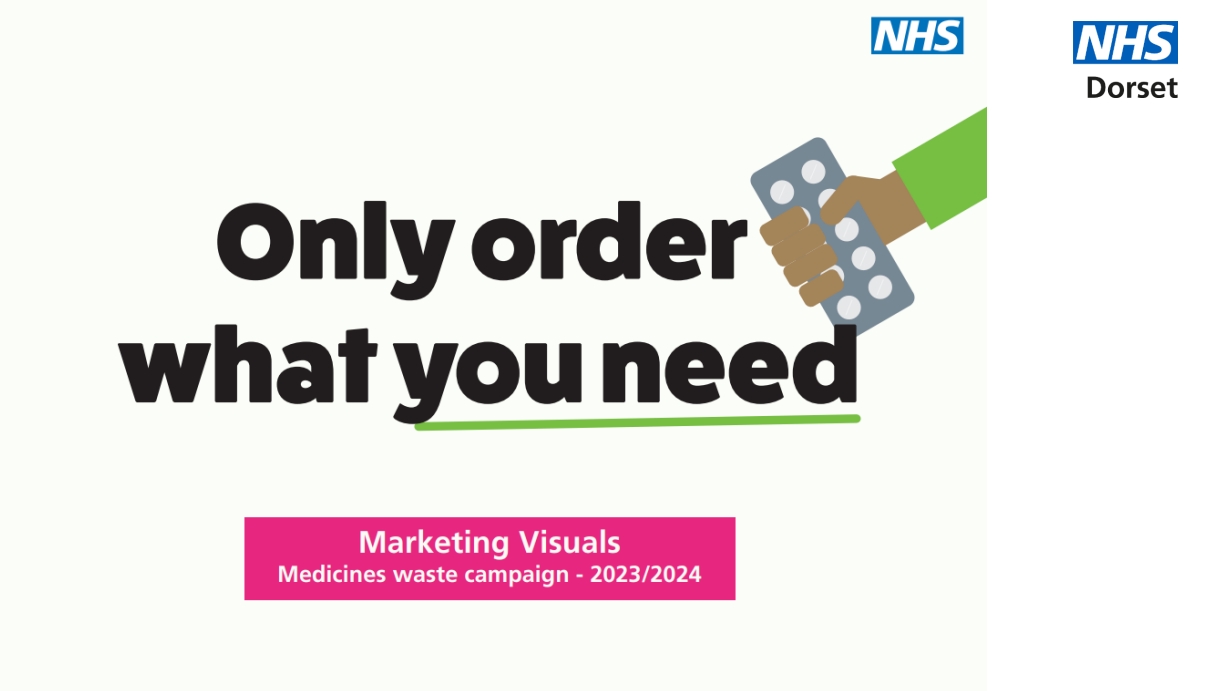 ICB medicines waste campaign
Medicines use accounts for 25% of the NHS’ carbon footprint. NHS Dorset’s Medicines Optimisation Team have created useful resources to support patients when ordering repeat medicines to reduce waste with an ICB-wide ‘only order what you need’ campaign.
Repeat prescription item growth decreased by 2.7% in the trial period, saving approximately £350–550k.
Practices that participated saw a roughly 4% reduction in repeat prescription requests.
PCN prescription alignment project
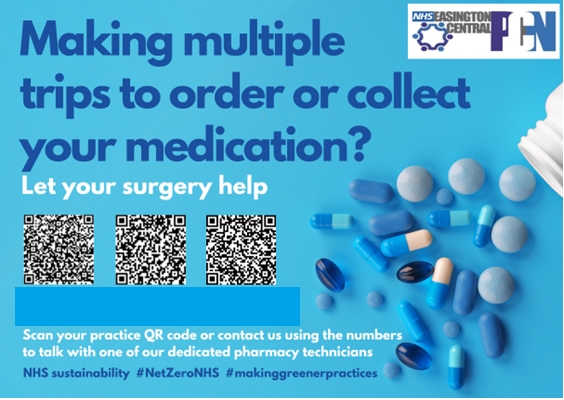 Easington PCN developed a prescription alignment project to enable a reduction in patient travel and associated carbon emissions created from repeat prescribing in primary care.
The community pharmacies advertised the service and directed patients to the prescription alignment forms. The service was delivered by pharmacy technicians and allowed a review of the medication requested and escalation to pharmacists for medication review where needed.
6.3 Example: Utilising digital capability to reduce workload
eRD e-learning
NECS developed an e-learning package in collaboration with NHS Digital. This learning covers eRD and how successful implementation of this can be of real benefit to GP practices, community pharmacy and patients. It also suggests a number of things to consider to enable the eRD process to be most effective, such as establishing a named lead for both the practice and the local pharmacy who will work together to overcome any issues, and the importance of starting small (patients on a stable regimen, with just one or two items on repeat) and growing the pool of target patients as confidence in the process grows.
Further resources for the implementation of eRD can be found at:
6.4 Example: QI improvement tools and case studies
A QI project undertaken by Citrus Health Primary Care Network
A QI project revealed significant challenges in managing repeat prescription processes at one of the surgeries in a six-practice PCN, highlighting high staff turnover, increased prescribing errors and staff burnout. The practice in a deprived area faced compounded issues due to poor patient attendance for monitoring, technological barriers, and inadequate local system amendments.
Implementing a new SOP and culture tailored to the practice's specific needs, alongside upskilling staff and improving communication channels, resulted in a marked reduction in errors and a substantial decrease in workload.
1. Initial challenges identified:
- High task volumes: Q1: 9,117 tasks, Q2: 10,034 tasks, Q3: 9,022 tasks
- System/process errors: 73.53% of total errors
- Significant under-reporting of prescribing errors
- 90% of medication requests via telephone.
2. Solutions implemented:
- New SOP and upskilling of admin staff
- Ledger-based system for transparent task management
- Fortnightly multidisciplinary meetings
- Engagement with NHSBSA for eRD data
- Switched to patient-led ordering as default system.
3. Positive outcomes achieved:
- Tasks reduced by 70% in Q4 (3,436 tasks completed)
- System/process errors dropped to 0% in the second audit
- Clinical human errors reduced by 50%
- Improved staff morale and retention. 0 reception staff departures compared with 6 in the previous year
- Increased patient satisfaction with 45% reduction in complaints
- 100% of ARRS staff report improvement in wellbeing and attitude to work.
The goodwill of staff was propping up an outdated and broken system. Since changes have been implemented, patients have increasingly embraced the NHS app and eRD and processes have been working more smoothly.
QI examples provided by the Primary and Community Transformation and Improvement team
Access to FutureNHS Platform is required.
- Case study on standardising medicines management: Improving management of repeat medication utilising staff within a PCN hub.
Bellingham Green, South Lewisham Group Practice, and the Jenner Practice in London, were receiving over 500 repeat prescription requests a week, some of which required a medication review. Staff were struggling to manage the reviews, with some GP appointments wasted when monitoring and test results were not synchronised with the medication review date.
The PCN Pharmacy Hub stepped in to provide support and now manages most reviews across the practices.
Impact:
- 53 administrative hours saved per week across the three practices
- 32 GP hours saved per week, across the three practices
- Patients receive reviews and their medicines in a timelier manner
- This project highlights the importance of collaboration and teamworking across a PCN.
https://future.nhs.uk/PrimaryCareImprovementCONNECT/view?objectId=33868720
https://future.nhs.uk/PrimaryCareImprovementCONNECT/view?objectId=30823952
6.5 Example: Supporting the safer prescribing of higher risk, repeat medicines
Opioids
Health Innovation Wessex, as part of the Medicine Safety Improvement Programme (MedSIP) worked in collaboration with local ICBs and PCNs to improve consistency of opioid prescribing for chronic, non-cancer pain.
The group have published a suite of resources including two PCN opioid checklists to help PCNs check if they have all elements in place to safely prescribe opioids. In response to local clinicians, they developed tools to help start discussions with patients who have been prescribed opioids long-term but who may be concerned about why their GP wishes to stop their opioid for chronic, non-cancer pain.
Joined Up Care Derbyshire have also published a number of opioid resources for patients and clinicians. Working in collaboration with Health Innovation East Midlands, they have created a practice-level opioid quality improvement toolkit and ICS minimum standards for repeat prescribing of opioids for chronic, non-cancer pain.
Antipsychotics in people with dementia
A toolkit has been developed by London Clinical Networks and Yorkshire and Humber Clinical Networks to support safer and more appropriate prescribing and deprescribing of antipsychotic medication.
NICE has a number of decision aids to support conversations with patients and there are key examples surrounding higher risk medicines, e.g., benzodiazepine or z drugs.
Antimicrobials on repeat prescription
The NHSE antimicrobial resistance team in the east of England have been championing a new COPD preventing exacerbations toolkit (PET) checklist with PCNs. The toolkit stemmed from a collaboration between NHSE and UKHSA to develop How to…? guides for PCN staff to support structured medication review of patients experiencing recurrent infection or exposed repeatedly to antibiotics. Two ‘how to’ guides have been completed (COPD exacerbation and acne) and are hosted on the RCGP TARGET website. Search strategies for GP systems have also been developed to identify this patient cohort.
6.6 Example: Engaging with patients
The following materials have been designed with patients and tested in primary care in England. They have been shown to help patients engage in their repeat prescribing and make the most of their structured medication review:
6.7 Supporting vulnerable patient groups
Frailty
Medication review in people at risk of falls is often not straight forward as people will often have multiple co-morbidities, be older and/or living with frailty, hence medicines use in this population requires a balance between the risks and benefits of multiple treatments.
The National Falls Prevention Coordination Group have produced a document for helping to review medicines of people at risk of falls.
Frailty and repeat prescribing of oral nutritional supplements (ONS)
The evidence base for frailty and malnutrition in older adults suggests limited evidence for oral nutritional supplements (ONS), with the patient group from the NIHR study stating we should ‘exercise caution’ in prescribing.
It is acknowledged that there is oversupply, risk of overuse and subsequent discharge from hospital without full assessment. This creates a significant follow up challenge for primary care. If followed up proactively after discharge, 61% of patients discontinue ONS (Barnet MSK project 2024, unpublished data).
Conversely, unintentional weight loss is frightening for patients and families and a trial of ONS may be appropriate (e.g., if awaiting diagnostic tests), with review to assess both efficacy and appropriateness. Clinical malnutrition (unintentional weight loss) can be classed as organic or psychosocial but often has elements of both and an aetiology-based approach is recommended to avoid overprescribing.
In considering if a repeat ONS prescription is necessary, it is essential to revisit the rationale for initiation, goals and adequacy of assessment and dietary advice.
Hertfordshire and West Essex ICB have some resources available and the Association of UK Dieticians has guidance around eating, drinking and ageing well.
Best prescription practice:
- A standard operating procedure within practice or medicines management team to manage repeat prescription requests, e.g., to include a process for tube-fed patients using ONS
- Use of acute prescriptions (or repeats with directions for follow up or length of prescription)
SMRs in those taking multiple medicines
Many patients report that they are not clear about the purpose of an SMR and may not feel able to share their concerns about their repeat medicines. To address this, Bradford and Leeds universities, in collaboration with patients and the Health Innovation Network Polypharmacy Programme, have developed a range of materials to support patients with their understanding of an SMR and how to get the most out of it.
These materials have been translated into several languages and are freely available.
People living in care homes
The care home support team across Coventry and Warwickshire have developed resources to support repeat prescribing for their care home residents. This includes support for ‘proxy ordering’. Care homes are encouraged to try to use one system for ordering repeat medicines for residents who are unable to order their own medicines, where possible.
NHSE offers guidance for proxy ordering.