The RPS Pay Gap 2024
- RPS Pay Gaps introduction
- April 2024: RPS gender pay gap
- April 2024: RPS ethnicity pay gap
1. RPS Pay Gaps introduction
A pay gap is the difference between the average rates of pay of employees in different groups across an organisation. It is used as a simple indicator of equality and fair career progression, allowing for comparisons between different organisations.
 Organisations with 250 or more employees have a legal obligation to report their gender pay gap every year. RPS has fewer than 250 employees. We report our gender and ethnicity pay gaps voluntarily as part of our commitment to equality and inclusion.
On the last reporting date in April 2024, female employees at RPS were paid 21.5% less on average than male employees. Employees from non-white ethnic minorities were paid 9% less on average than white employees.
These figures don’t mean that we have unfair pay disparities between people doing the same job but reflect levels of seniority in the organisation and employment patterns in our junior and mid-level roles. For example, we employ women and men in approximately equal proportions in our most senior roles, but women form a far higher proportion of employees in our junior and mid-level roles. The same is true to a lesser extent for employees from an ethnic minority.
Over the past few years, we have analysed the reasons for our pay gaps and carried out annual pay benchmarking to ensure that we are paying a reasonable market rate for all our job roles, looking at both external and internal comparisons. We have also introduced other initiatives such as gender-neutral advertising, and blind recruitment.
Our ethnicity pay gap has fluctuated but overall shows improvement since we began reporting in 2020. However, our gender pay gap has risen since we began reporting in 2019, and the actions we’ve taken so far have not been effective in addressing this.
We recognise that there are many complex factors that contribute to our pay gaps, including external labour market factors that we can’t influence directly. We have gone into more detail about this and the actions that we are taking in the separate reports for our gender and ethnicity pay gaps below.
2. April 2024: RPS gender pay gap
Breakdown of RPS gender pay gap for April 2024
Our 2024 report is based on 142 female and 65 male employees paid in the month of April.
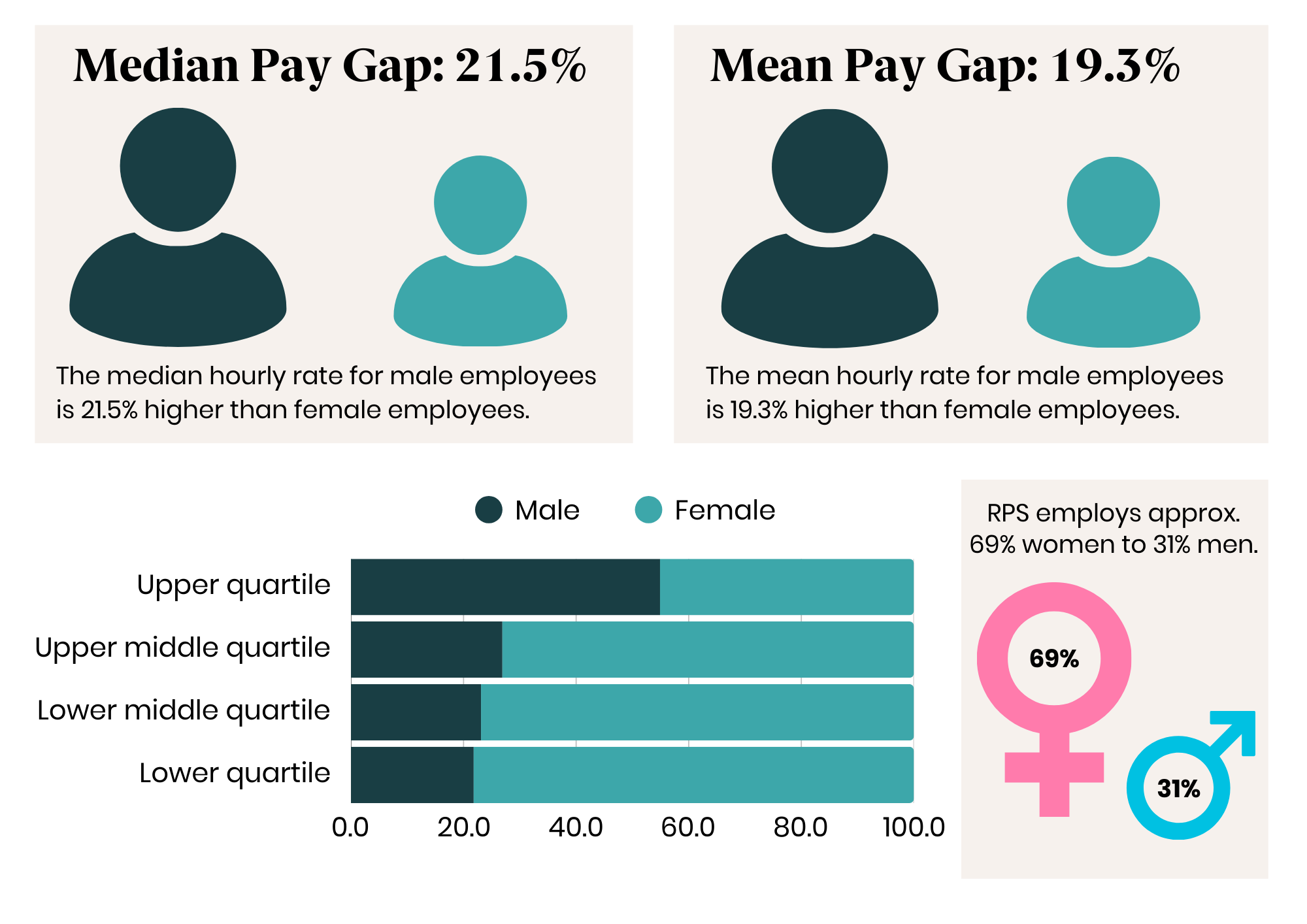
In April 2024, our median gender pay gap was 21.5%. This shows little change over the previous year but remains well above the national median of 13.1% (ONS, October 2024).
The main driver for our pay gaps is the composition of our workforce. We employ women and men in roughly equal proportions at senior levels in the organisation, and our Executive team is 50% female. However, women significantly outnumber men in our more junior roles.
In April 2024, women represented 69% of our total workforce, held 45% of posts in the upper pay quartile and 79% of posts in the lower pay quartile (the highest and lowest paid quarters of our workforce). Both quartiles showed a small negative shift, from 46% and 78% respectively in 2023.
In 2024, about 60% of applications for all advertised roles were from women, rising to up to 90% for some roles. Over the past few years, we have seen a gradual increase in the proportion of women employed at RPS, rising from 64% of our workforce in 2021 to 69% or 70% in recent years.
There are several reasons why we attract more women to many of our job roles. We offer excellent opportunities for flexible working, including at senior level, and much of our workforce falls within the pharmacy and publishing professions, where women predominate.
This pattern is reversed in our Technology department. We have a female CTO, but overall, 75% of Technology employees are male. Over the past two to three years, market forces and changes to our skills mix have driven up salary levels in this area, which in turn affects our gender pay gap.
Action to address the pay gap
Our gender pay gap would improve if proportions of men and women were more evenly balanced at all pay levels. At present, the proportions of men and women in our upper pay quartile are least reflective of the 61:39 ratio in the organisation. Our current focus for reducing our gender pay gap is to increase the proportion of female employees in our upper pay quartile to at least 50%.
We strongly support internal career progression for women and promote diverse application pools and shortlists for director and senior management vacancies. In 2024, we recruited 2 women and 1 man to senior management roles (head of department and above) and promoted two women internally to roles at this level.
Over the past four years, male and female employees have benefitted equally from in-year pay increases and promotions, in proportion to their numbers in the organisation. Men have done slightly better than women from pay benchmarking adjustments in most years, reflecting market rates for different roles. However, between 2023 and 2024, 7.7% of female employees received a pay benchmarking uplift, compared with 4.6% of male employees.
In 2024 we provided inclusive recruitment training for managers to ensure that our hiring managers have the skills to support objective recruitment decisions and to help reduce any potential bias that may exist in our recruitment processes.
Breakdown of RPS gender pay gap for April 2024
The charts below show the breakdown of our pay gap and proportions of female/male representation at all levels within RPS.
The figures should be looked at considering the percentage representation of each employee group in the whole organisation. We employ approximately 69% women and 31% men. If pay levels were evenly distributed between the two groups, we would expect to see these percentages approximately reflected at each quartile level.
3. April 2024: RPS ethnicity pay gap
RPS reports our ethnicity pay gap on a voluntary basis, in the same way we do our gender pay gap. We also measure the ethnic diversity of our employees at different levels in the organisation.
In the 2021 census, 81.7% of the England and Wales population identified as White, with the remaining 18.3% from non-white ethnic minorities.
Our 2024 report is based on 136 White and 68 ethnic minority employees paid in the month of April. These numbers represent 67% and 33% of our workforce respectively, an increase of 3.4% in the proportion of RPS employees from an ethic minority background since 2023.
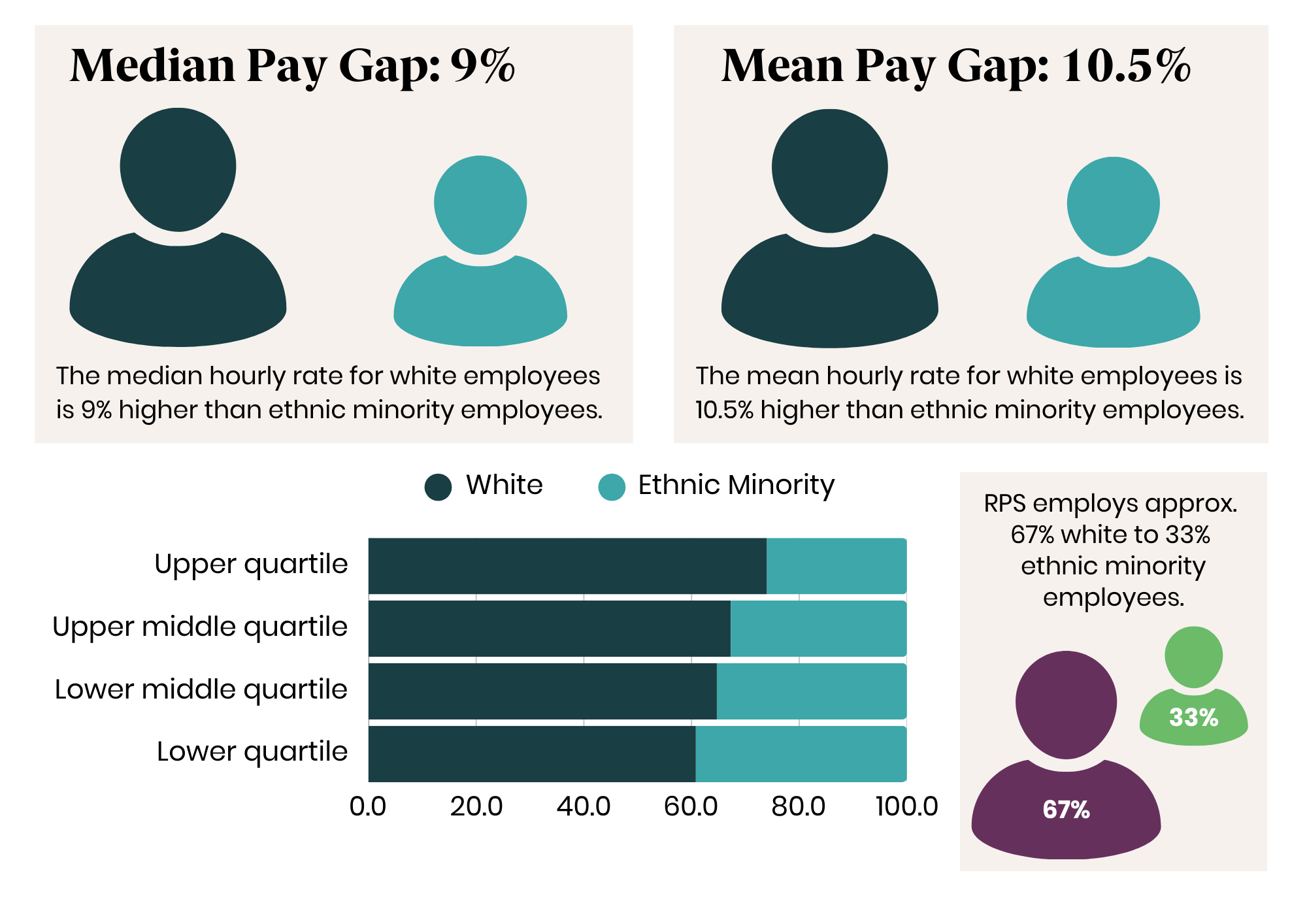
The median pay gap between our white and ethnic minority employees was 9% in April 2024, down from 10.1% in the previous year.
There is no simple comparison between the RPS white/ethnic minority pay gap and a national pay gap as there are differences between ethnic groups. Based on the ONS five -point categorisation1, pay gaps range from Mixed or Multiple Ethnic Groups, who earn 7.2% more than White workers, to Black or Black British who earn 5.7% less. (ONS, November 2023).
In April 2024, 33% of our employees were from non-white ethnic minorities. Asian or Asian British employees comprised 20% of our workforce, followed by Black and Mixed Ethnicity employees, both 6%, with other ethnicities making up the remaining 1%. Ethnic minority employees held 26% of posts in the upper quartile, up from 15.4% in 2023 and 12.2% in 2022. This was balanced by an upward swing from 28% to 39% representation in the lower pay quartile.
The improvement in upper quartile representation has been supported by increased recruitment to our Technology department, where over half of employees are from ethnic minorities.
In 2024, for the first time, we have broken down our pay gap using the ONS five-point categorisation. Our pay gap for Asian employees was 7.5% in 2024, compared with -3.3% nationally. Pay gap differences for the other groupings appeared to reflect national trends. We haven’t reported on these separately due to small numbers, which could make our findings statistically insignificant.
Action to address the ethnicity pay gap
Over the past four years of reporting, ethnic minority and white employees have benefitted equally in proportion to their numbers from annual pay benchmarking uplifts. Over the past two years, ethnic minority employees have also benefitted equally from in-year promotions and pay changes, an improvement on previous years.
To help improve pay gaps and career progression for racially disadvantaged groups, we are promoting diverse application pools and shortlists for director and senior management vacancies. In 2024, we recruited three people externally to senior management roles (head of department and above). These included one Black woman, one White woman and one White man.
Our focus for reducing our ethnicity pay gap is to increase the proportion of ethnic minority employees in our upper pay quartile to better reflect the overall ethnicity proportions in the UK population. In April 2024, 26% of our upper quartile employees were from an ethnic minority, up from 15.4% in 2023 and 12.2% in 2022. This means that in 2024 we exceeded our current target of at least 18% ethnic minority employees in our upper quartile roles. We will hope to see this trend continued in 2025.
In 2024 we provided inclusive recruitment training for managers to ensure that our hiring managers have the skills to support objective recruitment decisions and to help reduce any potential bias that may exist in our recruitment processes.
Breakdown of RPS ethnicity pay gap for April 2024
The charts below should be looked at considering the percentage representation of each employee group in the organisation. With about 67% white and 33% ethnic minority employees in the organisation, if pay levels were evenly distributed, we would expect to see these percentages approximately reflected at each quartile level.
1 White, Asian or Asian British, Black or Black British, Mixed or Multiple Ethnic Groups, Other Ethnic Groups.